A major rewrite, ten years on
The International Committee on Allergic Diseases of Animals (ICADA) has published its first full rewrite of the canine atopic dermatitis (cAD) treatment guidelines since 2015. The update, by Mueller, Banovic, Bensignor, Santoro and Nuttall, appeared in Veterinary Dermatology in 2026 and covers evidence published up to July 2026.
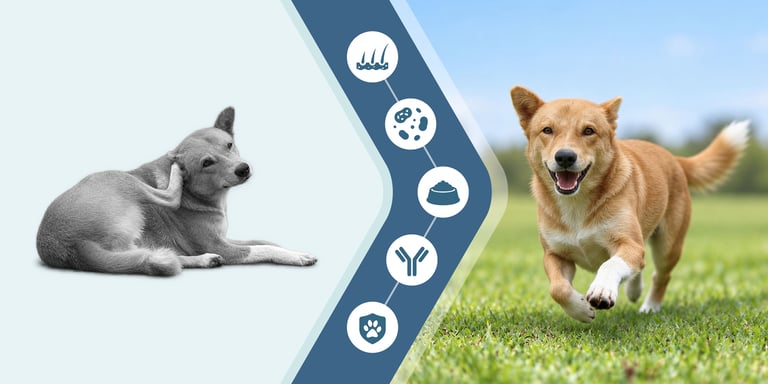
The headline: cAD is no longer treated as one disease with one fix. The guidelines now group treatments by how they work and split care into two phases. For practices, that means a stronger case for long-term, multimodal plans rather than treating flare after flare.
The big shift: reactive, then proactive
The guidelines replace the old acute/chronic split with two phases:
- Phase 1, reactive therapy. Resolve existing pruritus and lesions and induce remission, usually with fast, broad-spectrum drugs such as glucocorticoids. JAK inhibitors or lokivetmab can suit dogs with mostly acute or mild lesions.
- Phase 2, proactive therapy. Once signs are fully in remission, keep them there and prevent flares with regular long-term treatment aimed at each dog's triggers.
The authors stress that treatment should continue until lesions and itch have completely resolved before tapering. Stopping early raises the risk of a rebound flare. Preventing repeated flares also helps avoid chronic changes that are harder to manage.
Phase 2 is where skin barrier care, microbiome support, allergen avoidance, and immunotherapy come in.
Skin barrier care: the foundation of Phase 2
Regular bathing with a mild, nonirritating shampoo, once weekly or less often alongside other topicals, is a useful adjunct in cAD. This carries the guidelines' highest evidence grade (SOR A). Moisturising shampoos are likely the most soothing; anti-seborrhoeic formulas suit dogs with scaling.
For topical skin barrier products, the guidelines find variable-quality evidence supporting their use as adjunct therapy (SOR B). They work best combined with other treatments and in milder cases as regular proactive maintenance.
Several Dermoscent products are among the studies cited:
- ATOP 7® Mousse: mildly improved pruritus and lesions when applied twice weekly for two weeks.
- ATOP 7® spray and Essential 6® spot-on: a modest effect on pruritus and lesions in mildly atopic dogs in a small 8-week open trial. Similar findings were reported for Essential 6® spot-on in a small randomised controlled trial.
- ATOP 7® spot-on with lokivetmab: adding weekly bathing and the spot-on extended the time to a flare compared with lokivetmab alone.
Adverse effects were typically not seen with these topical products.
Microbiome modulation: an emerging option
The guidelines treat microbiome modulation as a promising, still-developing area. Topical products containing tyndallised or live probiotics are considered safe and effective for managing mild cAD (SOR C). They are best used regularly as proactive maintenance rather than for acute flares.
The cited evidence includes Linkskin® Spray, made of tyndallised lactobacilli, their culture media, vitamin D and polyphenols. In an open-label study, it significantly improved clinical signs in atopic dogs.
The guidelines are candid about the gaps. No change in the skin microbiome was detected in that study, and there is still limited evidence that topical probiotics alter the cutaneous microbiome. Larger controlled trials are the next step.
Allergen immunotherapy: the only treatment aimed at the cause
Allergen-specific immunotherapy (AIT) gets one of the clearest recommendations in the guidelines: it is recommended for all dogs with cAD caused by environmental allergens. The authors note its unique mechanism, which may prevent disease progression. Adverse effects are usually mild and transient.
Three practical points from the guidelines:
- Allow time. AIT usually takes months to work, so continue for at least a year before judging response, with anti-inflammatory support during induction.
- Choose allergens carefully. Intradermal testing or IgE serology both work for selecting allergens. Results should match the dog's history, seasonality, and likely exposure. These tests identify sensitisation but cannot diagnose cAD.
- Consider the route. Subcutaneous protocols have the most evidence. Rush induction appears as effective as conventional induction, and intralymphatic AIT may be at least as effective as subcutaneous.
The guidelines also identify owner compliance as a major factor in AIT success, which makes client support part of the treatment.
Elimination diets and infection control
Food. Every dog with year-round cAD should have one or more elimination diet trials to check whether food allergens contribute. Trials normally run 6–10 weeks on a commercial or homemade diet with few novel or hydrolysed ingredients. The guidelines are explicit that serum or skin tests for food allergens are not reliable for this (SOR A).
Infections. Bacterial and Malassezia infections are a key driver of flares and must be treated in both phases. Confirm them with cytology first. Topical antiseptics, most commonly chlorhexidine-based solutions with or without an antifungal, are the first line. Reserve systemic antibiotics for deep pyoderma or when topical therapy fails.
Recurrent infections always have an underlying cause, so the guidelines advise against repeated antimicrobial courses without addressing it.
Essential fatty acids: a modest supporting role
The guidelines give essential fatty acids (EFAs) a cautious place in cAD management. The authors suggest offering them as adjunct therapy, or on their own in very mild cases. The evidence shows only a limited decrease in lesions and pruritus, so EFAs are unlikely to control the disease alone. Their more practical value may be a drug-sparing effect: dogs on systemic glucocorticoids, ciclosporin or oclacitinib may need less of these drugs when EFAs such as Dr. Baddaky Omega-3 oil are added. That makes them worth considering for two groups: dogs with mild cAD, and atopic dogs already on one of those systemic treatments. Adverse effects are rare and usually limited to mild gastrointestinal upset, so clinical monitoring is all that is needed.
For practices looking to add EFAs to an atopic dog’s plan, Nextmune offers Dr. Baddaky Omega-3. It is a premium-quality fish oil produced in Norway with high levels of the essential omega-3 fatty acids EPA and DHA. It also contains an antioxidant and comes as either an oil or capsules, and it is given once daily with food. The guidelines’ evidence concerns EFAs as a product class rather than this specific product, so it fits best where the guidelines place EFAs: as an adjunct in mild cAD or alongside systemic therapy.
Putting it together
The guidelines' conclusion is that no single intervention is universally required, interchangeable or effective in every dog. A good long-term plan combines the options that fit each patient's triggers, lesion pattern, owner and budget. A typical Phase 2 plan might include:
- weekly bathing and a topical barrier product
- infection monitoring and topical antiseptics when needed
- flea control and, for year-round cases, an elimination diet trial
- allergen immunotherapy for dogs with relevant environmental sensitisations
- anti-inflammatory therapy where needed to hold remission
Nextmune supports veterinarians across this approach, from allergy testing and immunotherapy to topical skin care. Take a look at our upcoming events for 2027 or recordings of previous webinars here.
References
Mueller RS, Banovic F, Bensignor E, Santoro D, Nuttall T. Treatment of canine atopic dermatitis: updated guidelines from the International Committee on Allergic Diseases of Animals (ICADA). Veterinary Dermatology. 2026. doi:10.1111/vde.70128
Sign up to our monthly newsletter
Receive the latest news, great promotions, exclusive discount codes and tips & advice from our specialists.
Share article: