Part 1 of 2
When PAX 2.0 launches on 1 August 2026, it will include 25 new allergen components and an entirely new allergen group — the most significant panel expansion since the test's introduction. In this first post, we focus on the environmental additions: pollens, mites, moulds, and the new biting insect group.
How the new components were selected
The additions were not chosen arbitrarily. They were identified through AllerSIGHT, Infinity Bio's proprietary peptide library — the largest allergen epitope mapping study conducted to date in veterinary medicine. Over 6,000 dog and cat serum samples were analysed for IgE reactivity across a broad range of molecular components. Only those showing consistently high positivity rates were added to the panel.
Pollens
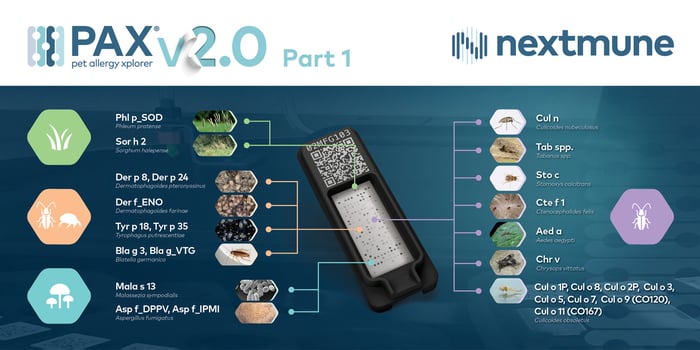
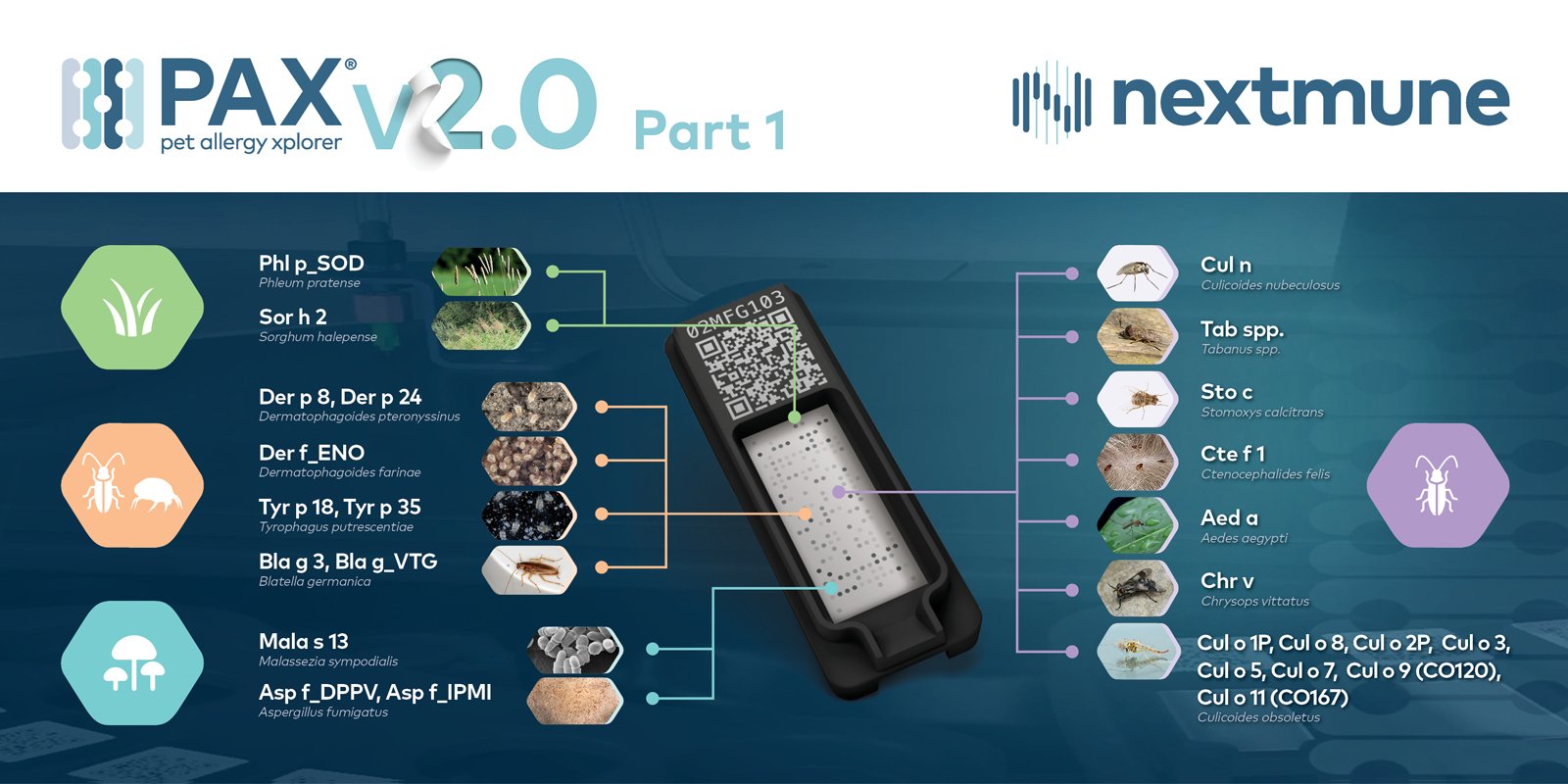
Three new pollen components have been added. In grass pollens, Phl p_SOD (Timothy grass, Phleum pratense) and Sor h 2 (Johnson grass, Sorghum halepense) broaden coverage of graminaceous sensitisation, which is among the most clinically prevalent in atopic dogs across temperate climates. In tree pollens, Que a 1 (White oak, Quercus alba), Jun a 7 (Mountain cedar, Juniperus ashei), and Bet v 7 (Silver birch, Betula verrucosa) extend the panel's reach into oak-juniper-cypress and birch groups — sources of IgE sensitisation that are increasingly relevant as geographic ranges and pollen seasons shift.
Mites and Cockroaches
New components include Bla g 3 and Bla g_VTG for German cockroach (Blatella germanica) — a common indoor allergen source in urban environments that has historically been underrepresented in veterinary panels. For house dust mites, Der p 8 and Der p 24 are added for Dermatophagoides pteronyssinus, and Der f_ENO for Dermatophagoides farinae, expanding molecular resolution within the mite group. Tyr p 18 and Tyr p 35 for Tyrophagus putrescentiae (storage mite) round out the additions — relevant particularly in animals exposed to grain-based foods or rural storage environments.
Moulds
Mala s 13 (Malassezia sympodialis) and Asp f_DPPV and Asp f_IPMI (Aspergillus fumigatus) are new additions. Malassezia sensitisation is a well-recognised complicating factor in canine atopic dermatitis; molecular-level identification of IgE reactivity to Mala s 13 adds diagnostic specificity. The Aspergillus components extend the panel's mould coverage.
Biting Insects — a new group for dogs and cats
A significant structural change in PAX v2.0 is the addition of bitting insects for the dog and cat panels. Biting insect hypersensitivity has long been recognised in horses — Culicoides midge sensitisation being the canonical example — but has been underdiagnosed in dogs and cats partly due to the absence of a validated diagnostic option.
The new biting insect group includes: mosquito (Aed a, Aedes aegypti), horse fly (Tab spp., Tabanus spp.), deer fly (Chr v, Chrysops vittatus), stable fly (Sto c, Stomoxys calcitrans), and multiple Culicoides components — Cul n (C. nubeculosus) and an extensive Cul o series (Cul o 1P, 2P, 3, 5, 7, 8, 9, 11) covering C. obsoletus.
The clinical picture in affected dogs and cats includes intense pruritus, often seasonal, with a distribution pattern correlating with bite-site exposure. The ability to confirm biting insect sensitisation now opens a more targeted diagnostic and management pathway.
PAX 2.0 is available from 1 August 2026. For questions, contact your Nextmune representative.