

We are pleased to share the following studies, presented in late August at the ESVD-ECVD congress in Lille. The main highlight is the poster "Analytical Performance of Three Canine Serum Allergen Tests Evaluated Using Artificial Sera with Predefined Allergen-Specific Canine IgE Monoclonal Antibodies," which systematically compares the analytical performance of three serological allergen tests in dogs. In addition, three further presentations were given during the Cutting Edge Program on Thursday, August 27th, further substantiating the findings on allergen-specific IgE diagnostics.
The poster: analytical validation of three serological allergen tests
The poster was authored by Freja Krogh and Lene Boysen (Vetgruppen Birkerød Dyrehospital, Denmark), with funding from Nextmune AB, the Danish Veterinary Dermatology Association, and Vetgruppen Birkerød Dyrehospital. The study addresses a methodological problem inherent to comparative research on serum allergen tests (SAT): because naturally sensitized dogs do not have a known IgE composition, discrepant results between laboratories cannot be attributed with certainty to true biological variation versus an analytical artifact of the test method used.
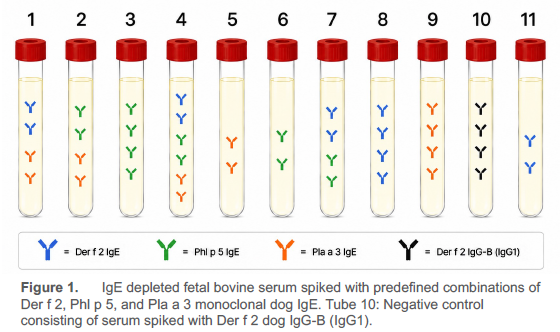
To resolve this, the authors employed a controlled experimental design. Artificial sera (IgE-depleted fetal bovine serum) were spiked with laboratory-generated, allergen-specific monoclonal canine IgE antibodies against three defined allergens: Phl p 5 (Phleum pratense, Timothy grass), Der f 2 (Dermatophagoides farinae), and Pla a 3 (Platanus). Eleven sera with predefined IgE composition were prepared, including one negative control consisting of Der f 2-specific canine IgG-B (IgG1), to test whether the assays erroneously detect IgG. Samples were coded, blinded, and randomized, then submitted by an independent external investigator to three European laboratories, each using a different testing methodology: PAX (Nextmune AB, Sweden; molecular allergology multiplex macroarray), MAC (IDEXX Laboratories, Hoofddorp; monoclonal antibody cocktail ELISA), and Allercept (LABOKLIN, Bad Kissingen; Fcε-receptor-based ELISA). Results were interpreted according to manufacturer thresholds and compared against the predefined IgE composition using sensitivity, specificity, percentage agreement, Cohen's kappa, and coefficient of variation (CV%).
Results
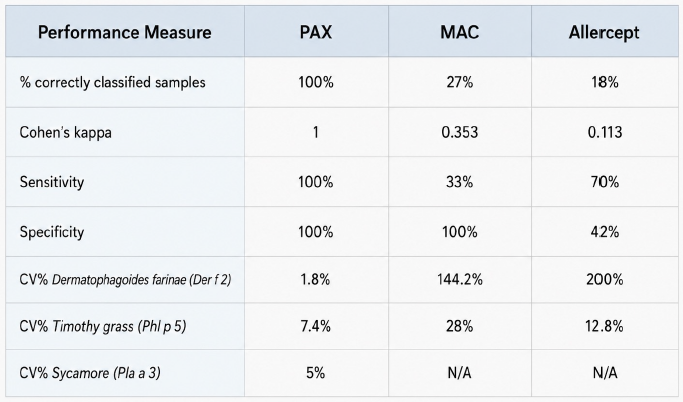
The three assays differed significantly in their ability to correctly reproduce the predefined IgE profiles. PAX correctly classified all 11 sera (100% sensitivity, 100% specificity, κ = 1.0; complete agreement). MAC correctly classified 3 of 11 samples, with 33% sensitivity, 100% specificity, and moderate agreement (κ = 0.353). Allercept correctly classified 2 of 11 samples and showed both false-negative and false-positive reactions, resulting in 70% sensitivity, 42% specificity, and poor agreement (κ = 0.113). The negative control was correctly reported as negative by both PAX and MAC, whereas positive reactions to the negative control contributed to the lower specificity of Allercept.
Intra-assay reproducibility was quantitatively assessed using four serum mixtures with identical, low concentrations of specific IgE against the same allergen. PAX showed a low coefficient of variation (1.8–7.4%), whereas both MAC and Allercept showed significantly higher variation (144.2% and 200%, respectively), indicating poor reproducibility at low IgE concentrations.
Interpretation and clinical relevance
The authors conclude that SAT methods are not analytically interchangeable. False-negative results may lead to the erroneous omission of relevant allergens from allergen-specific immunotherapy (ASIT), while false-positive results may lead to the unwarranted inclusion of irrelevant allergens. The superior performance of the molecular allergology-based test (PAX) is attributed to its use of defined allergen components, in contrast to crude allergen extracts, where variation in composition and low concentrations of relevant components likely contribute to the reduced sensitivity of the extract-based assays (MAC and Allercept).
A key strength of this study is the use of sera with a predefined, monoclonal IgE composition, enabling a direct accuracy assessment not achievable with naturally sensitized canine serum. The coded, blinded, and randomized sample submission minimizes the risk of interpretation bias. The authors note as a limitation that artificial sera may not fully reflect the biological complexity of naturally sensitized canine serum, and that further research is needed to determine how these findings translate to clinical practice.
Additional presentations at the congress
During the Cutting Edge Program on Thursday, August 27th, three additional free communications were presented, also based on large-scale PAX datasets:
Olivry and Mas-Fontao analyzed allergen-specific IgE responses to bee (Api m) and wasp (Ves v) venom in 34,151 dogs, 5,810 cats, and 4,612 horses tested with PAX across Europe in 2025. Component-resolved testing revealed substantial discordance with extract-based results: 40–59% of animals positive for a bee venom component tested negative to the parent extract, and 63–75% for wasp venom. The findings support the routine integration of component-resolved diagnostics into clinical practice, alongside geographic clustering of sensitization patterns across Europe.
Börjesson, Streets, and Olivry investigated the seasonal variability of pollen- and mite-specific IgE in Scandinavian dogs (n = 5,014 PAX results, March 2023–February 2024). Tree and weed pollen seropositivity peaked in spring and summer, while house dust mite seropositivity was significantly higher in autumn and winter, with an opposite pattern for storage mites. The authors conclude that the timing of serological sampling is relevant to the interpretation of test results. This study has been published open access (doi.org/10.3390/vetsci13060522).
Olivry and Mas-Fontao characterized species-specific sensitization profiles for house dust mites (Dermatophagoides farinae and D. pteronyssinus) in dogs, cats, and horses. Distinct molecular-level differences were identified: cats showed higher seropositivity to Der f 1, dogs to Der f/p 2 and Der p 11, and horses to Der p 5, 7, 10, 21, 23, and Der f 15. Seasonal dynamics also differed by species, peaking in summer in dogs and in autumn in horses, while cats showed the least seasonal variation.
Conclusion
Together, the four studies presented at this congress underscore the importance of methodological choices in allergen-specific IgE diagnostics: from the analytical reliability of the test method itself, to the added value of component-resolved diagnostics, to the effect of sampling timing on test outcomes. The poster by Krogh and Boysen provides the most direct evidence of this, being the first to quantify the analytical accuracy of three SAT methods using sera with a known, rather than assumed, IgE composition.