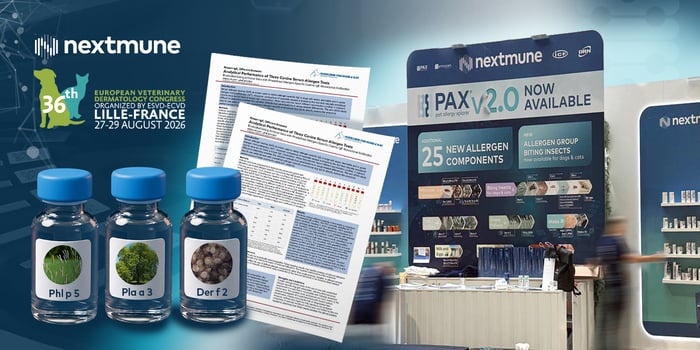

To objectively evaluate test accuracy, 12 blinded artificial sera with known IgE profiles were created using three canine monoclonal IgE antibodies (Phl p 5, Der f 2, Pla a 3/nsLTP). Two negative controls were included. Six commonly used U.S. allergy panels were evaluated.
Key Findings
- PAX correctly identified 100% of samples (12/12)
- All extract-based tests showed inconsistent performance
- Several assays demonstrated high false-positive or false-negative rates
- Reproducibility varied substantially between laboratories
Performance Overview
| Test | Correct Identification | Reproducibility |
| PAX | 100% | High (CV 15-35%) |
| IDEXX | 33% | Low-moderate |
| HESKA | 42% | Moderate |
| VARL | 0%* | Not assessable |
| NELCO | 8% | Not assessable |
| Pet Preferred | 42% | Variable |
*Except negative controls
Core Conclusion
Component-based molecular testing demonstrated superior diagnostic
accuracy and reproducibility compared to extract-based IgE assays.
Extract-based panels showed:
-
Low detection of relevant molecular allergens
-
High false-positive and false-negative rates
-
Inconsistent reproducibility
Clinical Implication
Test selection directly influences:
-
llergen selection for immunotherapy
-
Diagnostic confidence
-
Treatment decisions
Choosing a highly accurate and reproducible assay is essential for reliable
allergy management.
References
Olivry T, Mas-Fontao A, Spencer M. "Comparative accuracy of 6 common allergy panels." dvm360, March 31, 2026.