
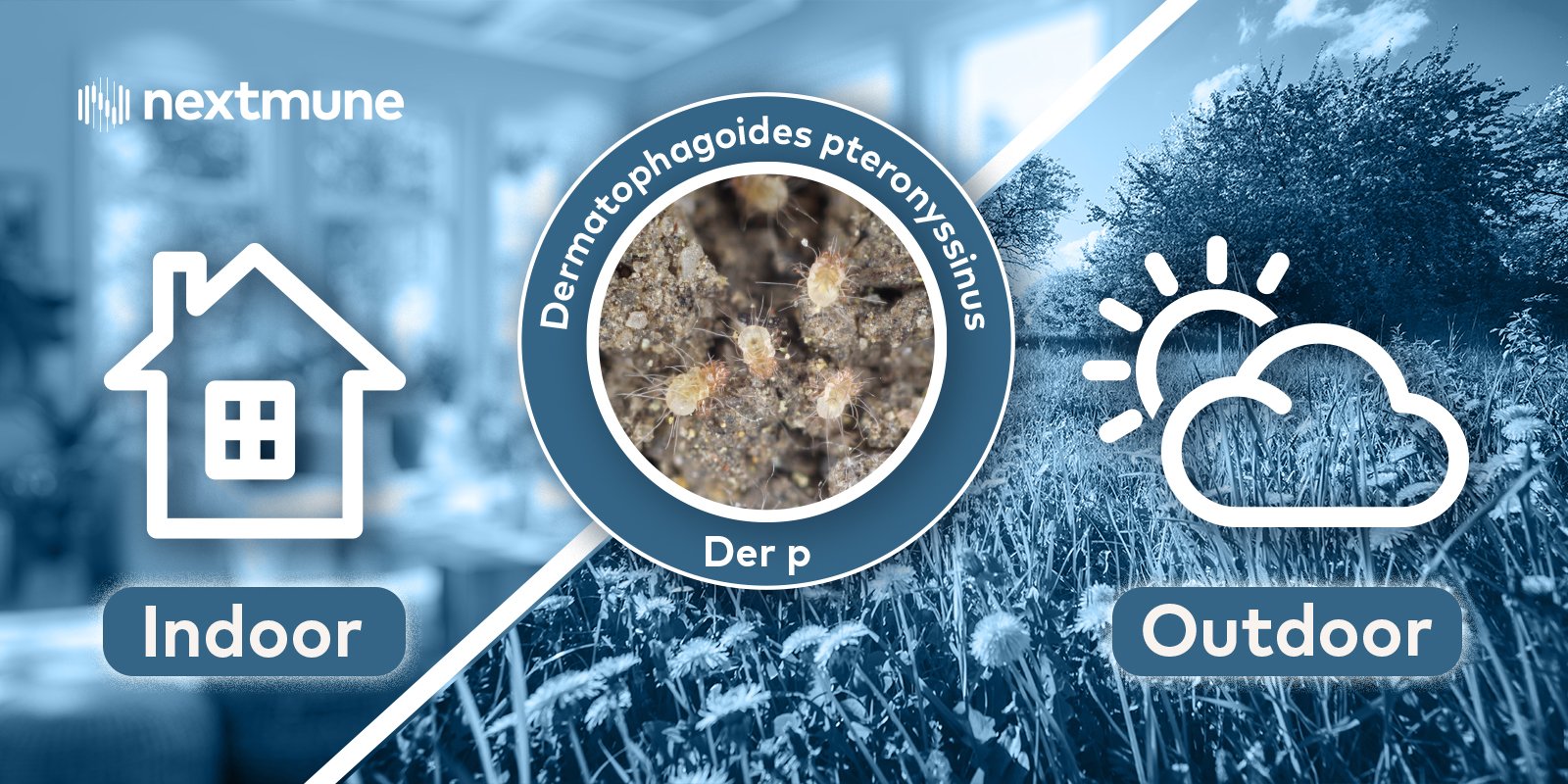
New insights on distribution, exposure, and the importance of test timing
Two recent studies shed new light on house dust mites (HDM): the first demonstrates that HDM DNA is detectable in outdoor air worldwide — including in temperate climates. The second, based on PAX test results from over 5,000 dogs across Scandinavia, shows that the season of blood sampling significantly influences sIgE test outcomes. Together, these findings offer direct practical value for the diagnosis and management of allergen-specific immunotherapy.
PAPER 1 — HDM DNA Detected in Outdoor Air Worldwide
What was studied?
Researchers at Nanyang Technological University in Singapore analysed 1,171 air samples from 33 countries for the presence of house dust mite DNA. In addition, air samples were collected both indoors (n=161) and outdoors (n=156) at 156 households across Singapore. The method — metagenomic sequencing of ultra-low-biomass bioaerosols — enables direct detection of mite DNA in the air, without reliance on traditional dust sampling.
Key findings
Dermatophagoides pteronyssinus (Der p) proved to be the most prevalent HDM species in outdoor air: detected in 208 of the 1,171 global samples. Prevalence increased toward the equator — in Singapore, 43% of outdoor air samples tested positive, compared with 25% in Malaysia and 20% in Brazil. HDM was also found in temperate climates: 13% of samples from Germany and 33% from France were positive.
Notably, in temperate climates HDM prevalence was higher in winter than in summer (20.7% vs. 9.8%). In Singapore, Der p was detected in 58.4% of indoor samples and 21.2% of outdoor samples — with comparable median DNA read counts, suggesting potential outdoor reservoirs beyond simple resuspension from the home.
Key insight
HDM exposure is not confined to the indoor environment. Animals — and people — can encounter allergen-bearing mite material outdoors, including in Europe.
Relevance for clinical practice
This has direct implications for allergen management advice to pet owners: even with thorough indoor cleaning and dust mite reduction measures, pets may still be exposed to HDM allergens outside. This could explain persistent sensitisation despite adequate indoor interventions and further underscores the value of allergen-specific immunotherapy.
PAPER 2 — Seasonal Influence on sIgE Testing in Dogs
What was studied?
In a retrospective study, Börjesson, Streets and Olivry (Nextmune) analysed PAX test results from 5,014 dogs in Denmark, Norway and Sweden over a full year (March 2023 – February 2024). For 17 allergens — including house dust mites (Der p, Der f), storage mites (Aca s, Tyr p), and tree-, grass- and weed pollens — both mean sIgE levels and seropositivity rates were compared across seasons.
Key findings
Mean sIgE levels showed statistically significant seasonal differences, but the magnitude of variation was modest. Seropositivity rates revealed clearer patterns:
-
Autumn / Winter
Higher seropositivity for house dust mites (particularly Der f). Increased time spent indoors likely intensifies exposure to HDM faecal allergens. -
Spring / Summer
Higher seropositivity for tree and weed pollens. Storage mites (Aca s, Tyr p 2) also peak during this period. -
Notable
Grass pollen showed no significant seasonal variation in seropositivity — possibly due to ongoing exposure via pollen on the coat or ground year-round.
Implications for test timing and interpretation
The study confirms that the timing of blood collection influences sIgE serology outcomes. For HDM, sampling in autumn or winter offers the highest likelihood of detection. Test results obtained outside the peak season may be falsely negative despite clinical signs — and vice versa.
The authors recommend considering the timing of sampling both when requesting and interpreting sIgE serology, ideally collecting blood when exposure to the suspected allergens is at its highest. Repeated longitudinal testing of the same patient can further improve diagnostic reliability.
What does this mean for your practice?
Together, the two studies yield three practical insights for the diagnosis and management of allergic dogs:
-
HDM exposure can occur outdoors. Allergen management advice to owners should not be limited to the indoor environment.
-
For HDM sensitisation, sampling in autumn or winter gives the highest chance of a positive result in a truly sensitised dog.
-
A negative HDM result outside the peak season does not rule out sensitisation. Consider retesting or correlate with the clinical picture.
References
-
Gusareva et al. Dermatophagoides pteronyssinus in ambient air bioaerosols. J Allergy Clin Immunol Glob. 2026;5:100667.
-
Börjesson T, Streets J, Olivry T. Seasonality of Serum Allergen-Specific IgE Levels in Scandinavian Dogs Suspected of Allergy. Vet Sci. 2026;13:522.