Itchy ears, a red belly, diarrhea that keeps coming back. As an owner, you look everywhere for a cause, and sooner or later the word "food allergy" comes up. But what does that actually mean, and why is it so hard to pin down? Here's the plain-language version.
Two kinds of alarm in the body
Your dog's or cat's immune system works a bit like a security team. The moment something unfamiliar comes in, an alarm goes off. With food allergy, that alarm actually happens in two very different ways, which is why "my dog is allergic to chicken" is rarely the whole story.
The first way is called **IgE-mediated**. Think of this as the fast guard. The body produces special proteins, antibodies called IgE, that stand watch. The moment they recognise a particular food protein, they hit the alarm button right away: histamine is released, and you see a reaction quickly, such as itching or swelling.
The second way is called **cell-mediated**. This is the slow guard. No antibodies are involved here; instead, a different type of immune cell (T-cells) remembers the protein and only reacts hours to days later. There's no bell that goes off instantly, just a slow-building reaction you notice later on.
Here's the key point: both guards can cause the very same symptoms in your pet, itching, ear infections, an upset stomach, but they play by completely different rules. And that has real consequences for testing and for diets.
Why a test gives clues, not a diagnosis
A blood test can pick up the fast guard, the IgE antibodies. That's useful, because it points to which proteins look suspicious. But the slow guard, the cell-mediated reaction, doesn't show up in blood. It simply doesn't work through antibodies.
That means a test never tells the whole story. Think of it as a compass pointing you in a direction, not a map with the answer marked on it. The result gives your vet something to work with when building an elimination diet, but the real confirmation only comes once your dog or cat visibly improves on that diet, and the symptoms return when the old food is reintroduced. That's the only way to establish food allergy with certainty.
Why one diet, strictly followed
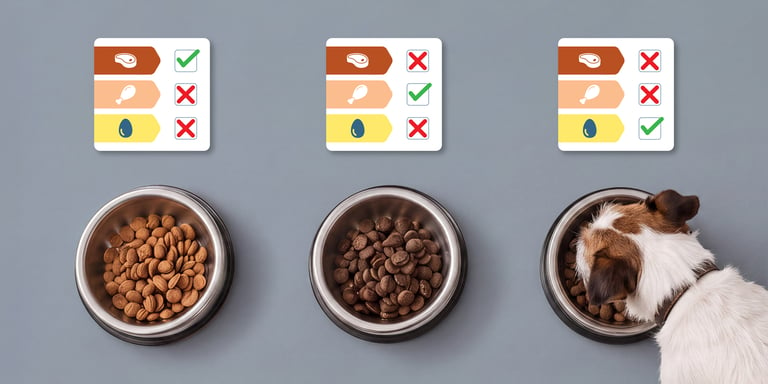
This is exactly why sticking to one diet, and sticking to it strictly, matters so much. No extra bite, no leftovers from the table, no "just to be safe" mixing in of a different food. Any stray protein that sneaks in can wake either guard back up. And once that happens, you can no longer tell whether the diet is working or not: the trial has been compromised before it really got started.
Sometimes one diet isn't enough. If your pet shows no improvement on the first elimination diet, that doesn't automatically rule out food allergy, it may simply mean that diet still contained the culprit protein, or something that looks enough like it to either guard. That has nothing to do with which guard, fast or slow, is behind the reaction; it comes down to whether that particular diet was truly clean. This is why your vet may want to try a second, differently composed diet before drawing a firm conclusion, for example switching from a diet with proteins broken down into very small pieces to a diet built around a genuinely novel protein your pet has never eaten (or the other way around). Two diets, two trial periods, but the surest route to a real answer.
When proteins look alike: cross-reactivity
There's one more twist: proteins from very different sources can be shaped so similarly that the immune system mixes them up. This is called cross-reactivity.
The best-known example comes from human medicine, and it makes the principle easy to picture: people who sneeze around birch pollen in spring often also get a tingling mouth from a raw apple. Strange? Not really, once you know that the protein in birch pollen is almost a twin of a protein in apples. The immune system recognises the shape, not the label, and reacts to both as if they were the same thing.
The same principle plays a role in animals too. An ingredient that looks "new and safe" on the label can still resemble, at the protein level, something your dog or cat is already sensitive to. That's why your vet doesn't just look at what's printed on the packaging when putting together an elimination diet, but also at which proteins might be look-alikes.
And so: no treats
Which brings us to a simple but important rule: don't give any treats during a diet trial. Not the chew stick for a bit of fun, not the leftover piece of cheese as a reward, not the popular snack at the checkout. A treat looks harmless, but it can easily contain the very protein the fast or slow guard reacts to, or something that resembles it closely enough. One biscuit can be the difference between a successful trial and starting all over again.
In short: food allergy in your dog or cat is never a matter of one simple test and done. It's a puzzle involving two kinds of immune reactions, where a test points you in the right direction but doesn't give the final answer, where strict adherence to the diet is essential, where two diets are sometimes needed, and where even a small treat can throw everything off. Patience and discipline pay off: working closely with your vet, that's how you get to a reliable answer.
Subscribe to our newsletter
Subscribe to our newsletter and don't miss our latest innovations in the fields of allergy, dermatology, and specialized pet nutrition.
Share article: